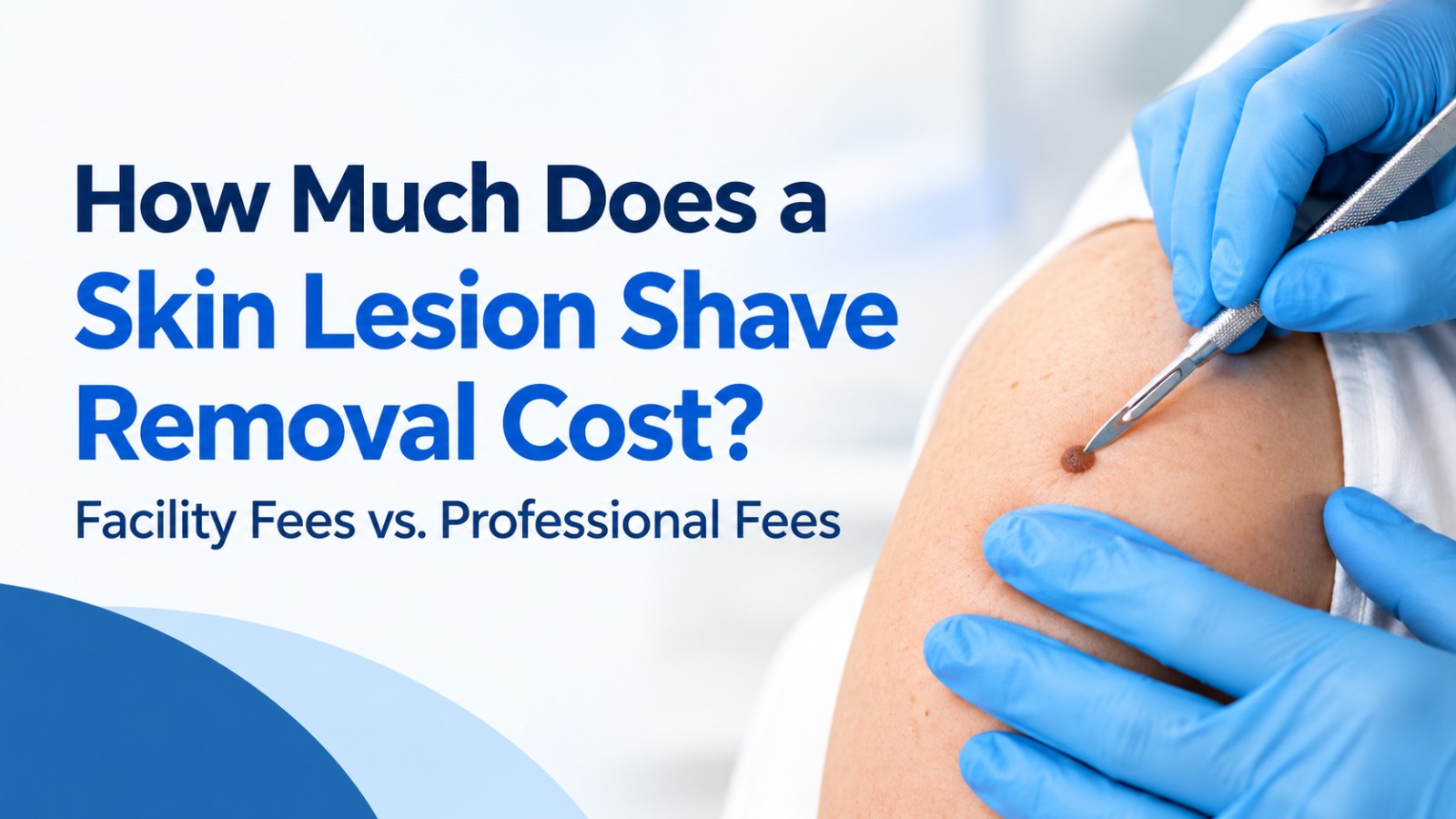
If your dermatologist recommends shave removal of a skin lesion, the procedure itself may seem straightforward but the price on your medical bill can be more complicated.
The amount you pay may depend on the type and size of the lesion, where it is located, the provider, facility, insurance coverage, pathology testing, and whether you receive separate professional and facility bills.
For consumers comparing healthcare costs, one of the most important questions is:
Is the quoted price the total cost or only the professional fee?
This guide explains how skin lesion shave removal is billed, what common CPT codes mean, how facility fees and professional fees differ, what pathology can add to your bill, and how to request a more complete cost estimate before treatment.
Quick Answer: How Much Does Skin Lesion Shave Removal Cost?
There is no single national price for skin lesion shave removal.
Publicly available 2026 pricing data shows that prices can vary substantially by provider and setting.
For example, a 2026 analysis of hospital price-transparency files reports a median published cash price of approximately $240 for CPT 11302, which represents shave removal of a single epidermal or dermal lesion measuring 1.1–2.0 cm on the trunk, arms, or legs. The dataset included 1,049 hospitals reporting a cash price.
Individual providers can publish different self-pay prices. One dermatology practice, for example, lists shave-removal prices from $225 for CPT 11300 to $340 for CPT 11303, depending on lesion size and location.
Another primary-care practice publicly lists prices ranging from $145 for CPT 11300 to $197 for CPT 11302 for certain shave-removal services.
These figures illustrate price variation, not a guaranteed price for your procedure.
Your total cost may also include:
-
Dermatologist/professional fee
-
Facility fee, if applicable
-
Pathology/laboratory fee
-
Additional evaluation or office-visit charges
-
Insurance deductible
-
Copayment
-
Coinsurance
-
Other services performed during the visit
The price for the shave removal itself may not equal the total amount you ultimately owe.
What Is a Skin Lesion Shave Removal?
A shave removal involves removing an epidermal or dermal skin lesion by shaving it at the skin surface rather than performing a full-thickness excision.
CPT coding distinguishes the procedure based on lesion size and anatomical location.
For lesions on the trunk, arms or legs, commonly referenced codes include:
The code changes for lesions located on the scalp, neck, hands, feet, genitalia, face, ears, eyelids, nose or lips.
This is important because "skin lesion removal" is not one standardized service or price.
Shave Removal vs. Shave Biopsy: Are They the Same?
Not necessarily.
Patients sometimes use terms such as:
-
Skin lesion removal
-
Shave removal
-
Shave biopsy
-
Skin biopsy
-
Mole removal
-
Skin tag removal
interchangeably, but they can represent different procedures and CPT codes.
For example, CPT 11301 describes shaving a single epidermal or dermal lesion measuring 0.6–1.0 cm on the trunk, arms or legs.
A tangential biopsy, on the other hand, uses different CPT codes, such as 11102.
The correct procedure depends on what your clinician is performing and why.
Before comparing prices, ask:
"What CPT code is being used for my procedure?"
That single question can make price comparisons much more meaningful.
Understanding the Two Main Parts of Your Bill
When healthcare services are provided in certain facility settings, you may encounter two different types of charges:
1. Professional Fee
The professional fee generally represents the clinician's services.
For a skin lesion procedure, this may relate to the dermatologist or other qualified healthcare professional performing the procedure.
It can include professional work such as:
-
Evaluating the lesion
-
Performing the shave removal
-
Local anesthesia as applicable
-
Clinical decision-making
-
Procedure documentation
The exact billing depends on the service and setting.
2. Facility Fee
A facility fee is a charge associated with the healthcare facility where a service is performed.
Depending on the setting, this could include costs associated with:
-
Facility resources
-
Clinical staff
-
Equipment
-
Supplies
-
Room/space
-
Administrative or operational overhead
Not every skin lesion shave removal will generate a separate facility fee.
A procedure performed in a dermatologist's office may be billed differently from one performed in a hospital outpatient department or other facility.
This is why asking only:
"How much does the procedure cost?"
may not give you the complete answer.
Instead ask:
"Is that price the professional fee only, or does it include any facility charges?"
Why Facility vs. Professional Fees Matter
Imagine you call a provider and are quoted:
"The procedure is $250."
Before assuming your total cost is $250, ask:
-
Is $250 the professional fee?
-
Is there a facility fee?
-
Is pathology included?
-
Is the office visit billed separately?
-
Are supplies included?
-
Will another provider bill me separately?
A quoted price without this context can make healthcare price comparisons misleading.
Does Pathology Add to the Cost?
It can.
If tissue from the lesion is sent to a laboratory or pathology provider for examination, there may be a separate pathology-related charge.
The procedure price and pathology price are not necessarily the same thing.
Your final cost can therefore look more like:
Professional procedure fee
-
Facility fee, if applicable
-
Pathology/laboratory fee, if applicable
-
Office/evaluation fee, if applicable
= Potential total healthcare cost
This is one reason consumers should ask whether the quoted price is all-inclusive.
What Determines the Cost of Shave Removal?
Several factors can influence your price.
1. Lesion Size
CPT codes vary according to lesion diameter.
For trunk, arm and leg lesions, for example, the codes progress from 11300 through 11303 as the lesion size increases.
A larger lesion may therefore be billed under a different procedure code.
2. Location of the Lesion
The CPT code can also change depending on where the lesion is located.
Different code groups apply to:
-
Trunk
-
Arms
-
Legs
-
Scalp
-
Neck
-
Hands
-
Feet
-
Genitalia
-
Face
-
Ears
-
Eyelids
-
Nose
-
Lips
For example, codes 11310–11313 apply to certain shave removals involving the face, ears, eyelids, nose and lips.
3. Facility Type
Where you receive care can affect the way services are billed.
Potential settings include:
-
Dermatology office
-
Physician office
-
Outpatient facility
-
Hospital outpatient department
-
Ambulatory facility
A facility-based procedure may involve charges that aren't present in a simple office-based service.
4. Insurance Coverage
If you're using health insurance, your actual out-of-pocket cost can depend on:
-
Deductible
-
Copayment
-
Coinsurance
-
Network status
-
Allowed amount
-
Whether the procedure is considered medically necessary
-
Whether pathology is covered
-
Your remaining out-of-pocket maximum
Important:
The provider's listed price is not necessarily the amount you personally pay.
How Much Does Skin Lesion Shave Removal Cost Without Insurance?
For self-pay patients, the price can vary widely.
A 2026 hospital price-transparency analysis reports a $240 median published cash price for CPT 11302 across 1,049 hospitals reporting a cash price.
But individual provider pricing can be different.
For example, one dermatology practice publishes the following shave-removal prices:
The same practice lists different prices for lesions on the scalp/neck/hands/feet and face/ear/eyelid/lip/nose areas.
Another practice lists $145 for 11300, $174 for 11301 and $197 for 11302.
What does this tell us?
Not that one price is "correct."
It shows that healthcare prices can vary between providers for the same CPT-coded service.
That's exactly why comparing prices before non-emergency care can be useful.
Is a Skin Lesion Shave Removal Covered by Insurance?
It depends on why the lesion is being removed and your specific health plan.
If a dermatologist considers the procedure medically necessary; for example, because the lesion requires evaluation; your insurance may treat it differently from a procedure performed solely for cosmetic reasons.
Your plan may have different rules for:
-
Medically necessary procedures
-
Cosmetic procedures
-
Biopsy/pathology
-
Office visits
-
In-network providers
-
Out-of-network providers
Before treatment, ask your insurer:
"Is CPT code ______ covered under my plan, and what will my estimated out-of-pocket cost be?"
Also ask your provider for the diagnosis code if appropriate, because coverage can depend on the combination of procedure and diagnosis.
What Is a Good Faith Estimate?
If you are uninsured or choose not to use insurance, federal rules generally require providers and facilities to provide a Good Faith Estimate (GFE) of expected charges when you schedule care in advance or request an estimate.
A GFE should include expected charges for healthcare items and services.
However, CMS explains an important limitation:
A Good Faith Estimate generally covers expected charges from a particular provider or facility.
If multiple providers or facilities will be involved, you may need estimates from each one.
For a skin lesion procedure, ask:
"Can you provide me with a written Good Faith Estimate that includes all expected charges from your office or facility?"
If another provider is expected to bill separately—for example, a pathology provider—ask whether that service will be included or separately estimated.
What If Your Final Bill Is Higher Than the Good Faith Estimate?
If you're uninsured or self-pay and receive a bill that is at least $400 more than the Good Faith Estimate from a provider, federal patient-provider dispute-resolution protections may apply.
Keep your:
-
Good Faith Estimate
-
Medical bill
-
Receipts
-
Provider correspondence
-
Insurance documents, if applicable
CMS recommends keeping the estimate so you can compare it with the eventual bill.
7 Questions to Ask Before Skin Lesion Shave Removal
Before scheduling the procedure, ask these questions:
1. What CPT code will be billed?
This helps you compare the same service across providers.
2. What is the professional fee?
Ask specifically for the clinician's charge.
3. Is there a facility fee?
If yes, ask how much it is and what it covers.
4. Is pathology included?
If the lesion is being sent to pathology, ask whether the pathology charge is included.
5. Is the office visit billed separately?
An evaluation may potentially be billed separately depending on the circumstances.
6. What will my insurance cover?
Ask your insurer about deductible, copay, coinsurance and network status.
7. Can I get the expected cost in writing?
For uninsured or self-pay care, ask for a Good Faith Estimate when applicable.
How to Compare Skin Lesion Removal Prices
Don't compare providers using only:
"Skin lesion removal — $___"
Instead, build a more useful comparison.
This approach helps you compare the expected total cost, rather than comparing one isolated fee.
Professional Fee vs. Facility Fee: Simple Example
Suppose Provider A tells you:
Professional fee: $250
Provider B tells you:
Procedure price: $300
At first glance, Provider A looks cheaper.
But imagine Provider A has:
-
Professional fee: $250
-
Facility fee: $150
-
Pathology: $100
Potential total: $500
Provider B has:
-
Procedure: $300
-
Pathology: $100
Potential total: $400
Provider B could therefore have the lower overall expected cost despite having the higher initial procedure price.
This is a hypothetical example, not a typical or guaranteed price.
The lesson:
Don't compare the first number you hear. Compare the expected total.
Shave Removal vs. Excision: Why the Difference Matters
A shave removal isn't the same as a surgical excision.
A shave procedure removes the lesion by shaving at the surface, while an excision generally involves removing the lesion with a deeper/full-thickness technique and may involve closure.
The appropriate procedure depends on the lesion and the clinician's assessment.
That's why you shouldn't choose a procedure simply because it appears cheaper.
Your healthcare provider should determine the appropriate treatment.
For suspicious or changing lesions, clinical evaluation is particularly important.
How TrueCareCost Can Help You Understand Healthcare Costs
Healthcare pricing can be difficult to compare because the first price you see may represent only one component of your expected cost.
TrueCareCost is designed to help consumers understand and compare healthcare costs before making healthcare decisions.
When comparing a procedure such as skin lesion shave removal, look beyond the headline price.
Consider:
Procedure → CPT code → Provider → Facility → Professional fee → Facility fee → Pathology → Insurance/out-of-pocket cost
The goal isn't simply to find the lowest number.
The goal is to understand what you're actually comparing.
👉 Explore healthcare costs with https://truecarecost.com
Check. Compare. Understand.
Frequently Asked Questions
How much does a shave biopsy cost?
A shave biopsy is different from shave removal and may use a different CPT code. The price depends on the provider, location, insurance, facility and whether pathology is performed.
How much does skin lesion removal cost without insurance?
There is no single U.S. price. Current public pricing examples show shave-removal prices ranging from roughly the low hundreds of dollars for the procedure itself, with significant variation between providers and settings. Additional pathology, facility or evaluation charges may apply.
Does skin lesion removal have a facility fee?
It depends on where the procedure is performed and how the provider bills. An office-based procedure may not have a separate facility fee, while facility-based care may involve separate facility charges.
Is pathology included in skin lesion removal?
Not necessarily. If tissue is sent to a pathology laboratory, there may be a separate pathology charge.
What CPT code is used for shave removal?
Several CPT codes can apply depending on the lesion's size and location. For example, 11300–11303 cover certain lesions on the trunk, arms and legs, while different code ranges apply to other anatomical locations.
Can I ask for a Good Faith Estimate?
Yes. If you are uninsured or self-pay, you generally have the right to request a Good Faith Estimate for scheduled care.
Can I compare skin lesion removal prices between providers?
Yes. For non-emergency care, you can ask different providers for their expected charges and compare the same CPT-coded service and included services.
Conclusion
The cost of skin lesion shave removal isn't determined by one number.
Your healthcare cost can depend on:
-
Lesion size
-
Lesion location
-
CPT code
-
Provider
-
Facility
-
Professional fee
-
Facility fee
-
Pathology
-
Insurance coverage
-
Deductible
-
Coinsurance
-
Other services provided
Current 2026 public pricing data demonstrates that even the same CPT-coded shave-removal procedure can have different published prices across healthcare providers.
So before scheduling:
Don't ask only, "How much is the procedure?"
Ask:
"What will my expected total cost be, and which fees are included?"
Then compare your options.
Know the cost before you book.
Compare before you pay.
Explore TrueCareCost to understand and compare healthcare costs.
Medical/financial disclaimer:
This article is for general healthcare-cost education and is not medical, insurance, legal or financial advice. Prices and coverage vary by provider, location, procedure, insurance plan and individual circumstances. Always confirm the procedure, CPT code, expected charges and coverage directly with your healthcare provider and insurer.